Mostrando postagens com marcador #edcmooc. Mostrar todas as postagens

sábado, 23 de fevereiro de 2013

E-learning and Digital Cultures - Digital Artefact

And here we are almost at the end of the 5-week MOOC E-learning and Digital Cultures. Our final task is to prepare a digital artefact to represent at least one broad theme that was discussed throughout this period.
As a journalist and teacher, I tend to think much more about "texts" than about "images", so it was quite a challenge to avoid writing pages and pages and to summarize my ideas into a digital artefact.
Actually, I didn't prepare one, but a set of three pieces: an image and two videos.
I choose a dystopian view of the future, and decided to represent three main topics: the future of Education (through the image), the idea of transhumanism, and surveillance (through the videos).

In order to do this, I used the following websites and tools:
www.thinkstock.com (image bank)
www.musopen.org (public domain music)
www.flickr.com (to host the image)
www.youtube.com (to host the videos)
www.blogger.com (to host this post and all the elements together)
Adobe Photoshop (to treat and prepare the images)
Windows Movie Maker (to produce the videos)

Here you are the results of my work:

The future of Education?
http://www.flickr.com/photos/vanessaprata/8499967095/in/photostream

Surveillance
http://www.youtube.com/watch?v=6gw0XWAn2uU&feature=youtu.be

Transhumanist M.O.M.
http://www.youtube.com/watch?v=wV-2d1qkLps

Hope you liked!

segunda-feira, 4 de fevereiro de 2013

E-learning - Week 2

Johnston, R (2009) Salvation or destruction: metaphors of the internet. First Monday, 14(4).http://firstmonday.org/htbin/cgiwrap/bin/ojs/index.php/fm/article/view/2370/2158

The first text this week discusses if the internet is salvation or destruction, and analyzes some metaphors to describe it. Here is a mind map with my own ideas, and some from the resources of the course.


domingo, 3 de fevereiro de 2013

E-learning - end of Week 1

Here are some things my colleagues posted about the first week of E-learning and digital cultures. Unfortunately there are too many things to get updated and even to select, so this is just a random selection.

Comic strips posted by Val - https://lessonselearned.wordpress.com/2013/02/03/calvin-and-hobbes-on-education-and-technology-edcmoocs/comment-page-1/#comment-4


A summary of all the films mentioned so far about utopian/dystopian by Michele Schwertner


sábado, 2 de fevereiro de 2013

E-learning and digital cultures - Week1

Getting to the end of week 1 of my first online course - E-learning and Digital Cultures, from The University of Edinburgh, and the general feeling is that it's a very interesting course, although I did feel overwhelmed (so did many other colleagues, it seems).

The main difficulty is not actually reading the texts, even though there were five, or watching the short films, but trying to get update with most of the discussions going on in the forums, the posts in Twitter and blogs, plus all the other suggestions for extra reading, other videos and so on that everyone keeps on posting. Obviously it's impossible to follow everything, but sometimes we (at least I did) have the impression that we are missing something.

Besides, this first week was the hardest, I hope, because I was getting used to the online format of the course, to the website itself and trying to take a look at all digital tools suggested for the final assignment, about which I haven't even started thinking yet.

Well, with so much going on, I though it was hard to reflect deeply and write about each text we read, and even harder to create something digital, as I'm much more of writing than working with images. So, I decided to use one of the suggested tools (www.wordle.net), which I found the easiest one, and just create "word clouds" for each of the texts, and a general one, including all the of them. I believe by looking at these images we can recall the most important points of each text and, mainly, reflect about what they have in common and how they differ.

Text 1 - Chandler, D. (2002). Technological determinism. Web essay, Media and Communications Studies, University of Aberystwyth.
  Wordle: E-learning-text1

Text 2 - Dahlberg, L (2004). Internet Research Tracings: Towards Non-Reductionist Methodology. Journal of Computer Mediated Communication, 9/3
Wordle: E-learning-text2

Text 3 - Daniel, J. (2002). Technology is the Answer: What was the Question? Speech from Higher Education in the Middle East and North Africa, Paris, Institut du Monde Arabe, 27-29 May 2002.
Wordle: E-learning-text3

Text 4 - Noble. D. (1998). Digital Diploma Mills: The Automation of Higher Education. First Monday 3/1.
Wordle: E-learning-text4

Text 5 - Prensky, M. (2001). Digital Natives, Digital Immigrants. On the Horizon, 9/5.
Wordle: E-learning-text5

General word cloud
Wordle: E-learning-general

What's your view on that?

segunda-feira, 28 de janeiro de 2013

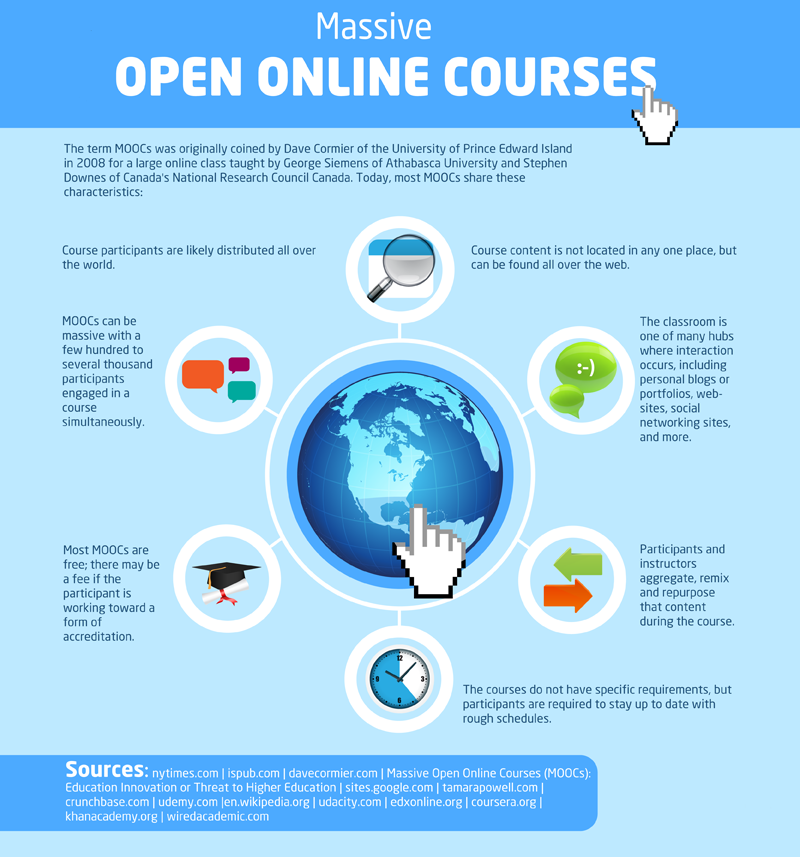
Have you heard about MOOC courses?

Source: http://www.onlinecollege.org/2012/08/21/25-tips-make-most-mooc


25 Tips to Make the Most of a MOOC

Massive online open courses (also known as MOOCs) are quite popular these days. A huge, or massive, version of open online courses, these classes bring thousands together, often around the world, to learn simultaneously. Discussions, connections, and learning are the focus on MOOCs, but with the low level of commitment and their overwhelming nature, it’s easy to get disconnected. Read on, and we’ll share 25 ways to stay in the loop, on task, and get the most out of your MOOC experience.
  1. GET CONNECTED:

    It’s easy to lose interest and drop out of a MOOC, but don’t let that happen. Find at least one other person to keep you connected to the course, and you’ll be much more likely to stay on track.
  2. INTRODUCE YOURSELF AND SHARE WAYS TO CONNECT:

    Be sure that you’re easy to find if your coursemates would like to connect with you. Share your Twitter, blog, and even a friendly image so that they know how to find you.
  3. START YOUR OWN DISCUSSION:

    A great way to get connected with others in your course is to post a thoughtful reply to a discussion, or create your own discussion. Just be sure to get out there and get involved, you’ll find much more value in the course if you participate with others.
  4. COMPLETE MAJOR PROJECTS:

    If you really want to get the most out of your MOOC experience, take part in all of the major projects along with the class.
  5. OFFER ASSISTANCE TO OTHERS:

    Help out your classmates. If they seem to have trouble with a concept that you feel you understand, step in and offer some assistance. You just might learn something yourself.
  6. DON’T GET OVERWHELMED:

    A MOOC is, by definition, massive, and there will be lots of posts to your course groups that you can read, but you don’t have to. Remember that you don’t have to read every single thing. Save time by getting a daily digest of posts and scanning it for interesting conversations that you’d like to take part in.
  7. DON’T BE OVERWHELMING:

    Do your classmates a favor: get to the point. Be concise in your discussions, questions, and answers so that everyone else can quickly skim through your contribution to the discussion.
  8. USE DESCRIPTIVE TITLES:

    A great way to help others better understand what you’re getting at is to use descriptive titles. That way they can skim and decide if they want to read your discussion or not.
  9. CREATE YOUR OWN CONTENT:

    As you begin to understand the course content, you may have reflections of your own. Share videos, concept maps, and more to share with your classmates, and have them to reflect on later.
  10. ASK QUESTIONS:

    Don’t be afraid to speak up if you have a question or an interesting discussion to spark. You’ll be able to better understand a concept, and may even be able to shed some light on information for others who were wondering, too.
  11. JOIN SUB-GROUPS:

    A great way to stay on top of discussions without being overwhelmed is to join sub-groups, where you can share what’s really important to you in the course.
  12. SET UP YOUR OWN BLOG:

    Although you’ll certainly be participating in online discussions, a blog is a great place to collect and share your own thoughts on a course. It’s a good idea to have an online home for your conversations that will live on even after the MOOC is over. Try to post to your MOOC blog at least once a week, and reference to it when applicable.
  13. GET ON TWITTER, TOO:

    Chances are good that plenty of MOOC discussions will be happening on Twitter. Be sure to get on the service and find out what the course hashtag is.
  14. CREATE YOUR OWN ARCHIVE:

    With tools like Scoop.it, you can create an archive of all of the great resources you’ve found in your MOOC.
  15. DESIGNATE AN EMAIL ADDRESS:

    Use your usual email address for a MOOC, and you’re bound to get overwhelmed quickly. Create a dedicated email address that you use only for MOOC learning, or set up filters to keep posts out of your run-of-the-mill inbox.
  16. SET UP A YAHOO! PIPE:

    Yahoo! Pipes are a great way to stay on top of MOOC post aggregation. You can bring in RSS, Google Groups, even Twitter and Flickr.
  17. PLAN WHAT YOU WANT TO GET OUT OF IT:

    Do you just want to follow along? Get credit? Start your own learning module? Have a clear idea of what you want to get out of a MOOC before you even get started.
  18. GET ORIENTED EARLY ON:

    Determine where and when everything is so that you don’t get left behind. Find the materials, important links, and times of the sessions that you want to participate in.
  19. STAY ON SCHEDULE:

    It’s easy to get behind when there’s so much coming at you all at once. That’s why getting oriented and determining your goal is so important. Decide what you want to participate in, and then schedule a time to do just that. Plan when you’ll read discussions, remember sessions, and carve out time for readings so that you’ll always be available to give learning your full attention.
  20. MAKE A COMMITMENT TO YOURSELF:

    When no one is holding you accountable, it’s tempting to let things slip. But stay committed and stay active, and you’ll reap the full benefits of the course.
  21. GET A CERTIFICATE:

    If you’re going to do the work, why not get credit for it? Many MOOCs offer the option to get a certificate for course participation; find out what the requirements are and what you’ll need to do to get one.
  22. FIND A JOB:

    It’s rumored that star performers in MOOCs just might be snapped up by dot-coms in need of star talent. Students who ace problems and never miss a quiz, engage in high-level discussion, and show their passion for the subject really stand out, and some employers are beginning to take notice.
  23. USE YOUR MOOC EXPERIENCE TO GET COLLEGE CREDIT:

    As Inside Higher Ed explains, you can use MOOC in your prior learning portfolio to get actual college credit for your work, even if it’s not directly from the MOOC administrator.
  24. BE PERSISTENT:

    MOOCs are an educational marathon; don’t give up before you’re done. Put in the time and effort necessary to stay with it, persistently connecting, building your network, and learning.
  25. …BUT DON’T BE AFRAID TO TAKE TIME OFF:

    MOOCs can be overwhelming; if you need a break, take a little time off to relax and start again. Pick things up next week with a new topic.